


Many people have probably seen this world-famous photograph known as “Afghan Girl.” The portrait of a girl in a worn red head covering, with piercing green-grey eyes, became one of the most recognisable images of the twentieth century and something of a visual icon of modern Afghanistan.
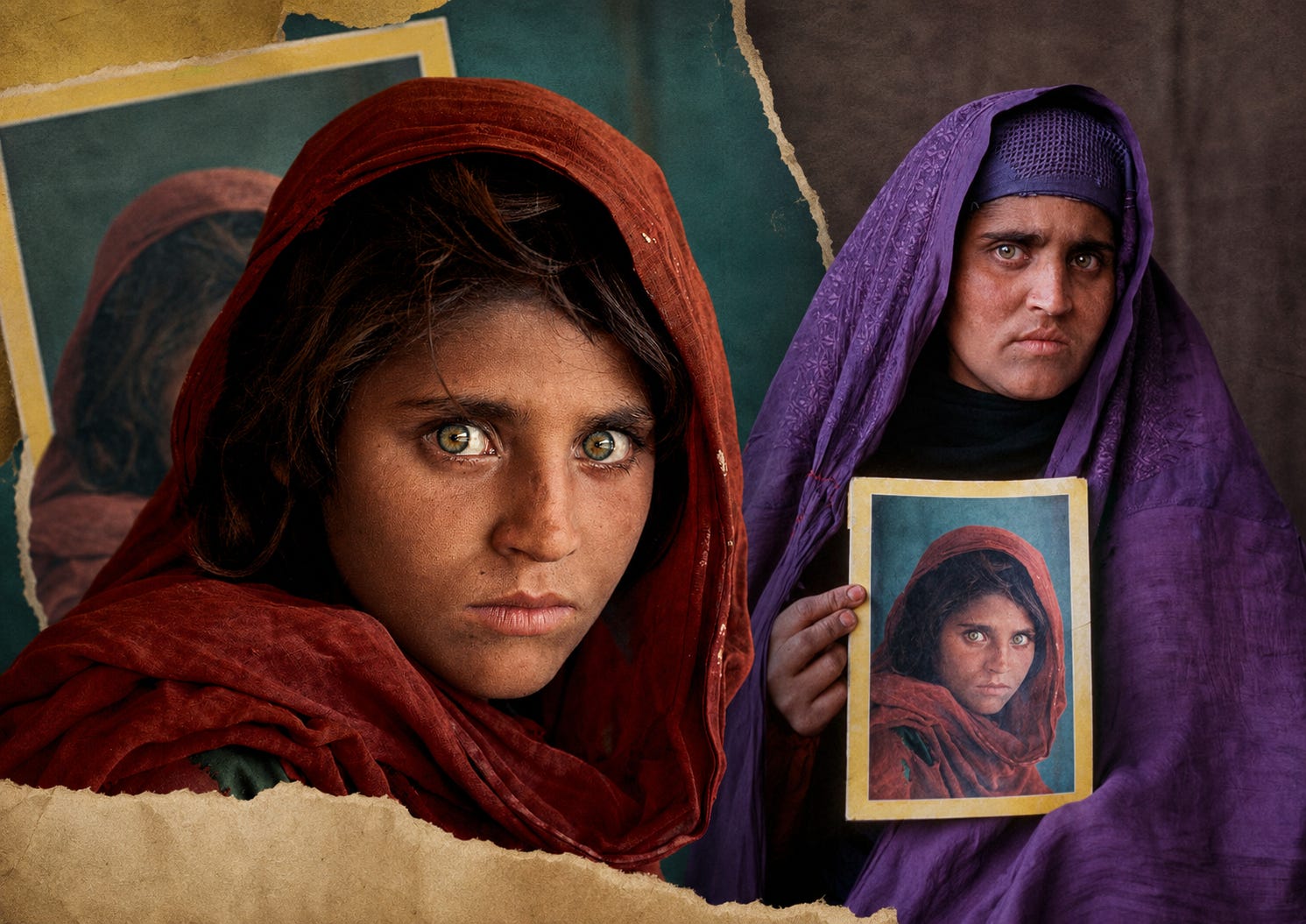
The photograph has even been called the “Afghan Mona Lisa” - probably because of the girl’s mysterious expression, her direct gaze, somehow both vulnerable and hostile, the ambiguity of the emotion in her face, and the extraordinary recognisability of the image.
But behind this famous portrait lies more than the story of how one of the world’s best-known photographs was created.
It is also a story about how a real person can gradually disappear behind an image created and interpreted by others.
A Portrait Taken in a Refugee Camp
The photograph was taken by American photojournalist Steve McCurry in December 1984.
Importantly, it was not taken in Afghanistan itself, but in the Nasir Bagh Afghan refugee camp near Peshawar, Pakistan.
The girl and her family had ended up there after fleeing the war that followed the Soviet invasion of Afghanistan.
There was an improvised school for girls in the camp. According to McCurry, he heard children’s voices coming from a tent, went inside and asked permission to take several photographs.
Among the pupils, he noticed a girl in a red head covering sitting slightly apart from the others.
She was around ten to twelve years old. She had probably never been photographed before.
The session lasted only a few minutes. McCurry took a series of portraits, and then the girl left.
He did not even write down her name.
At the time, the photographer had no idea that this particular frame would become the defining image of his career - or that the face of this unknown child would appear on the cover of one of the world’s most famous magazines.
A Gaze That Was Immediately Given a Meaning
When the portrait appeared on the cover of National Geographic in June 1985, it quickly became one of the most famous images in the magazine’s history.
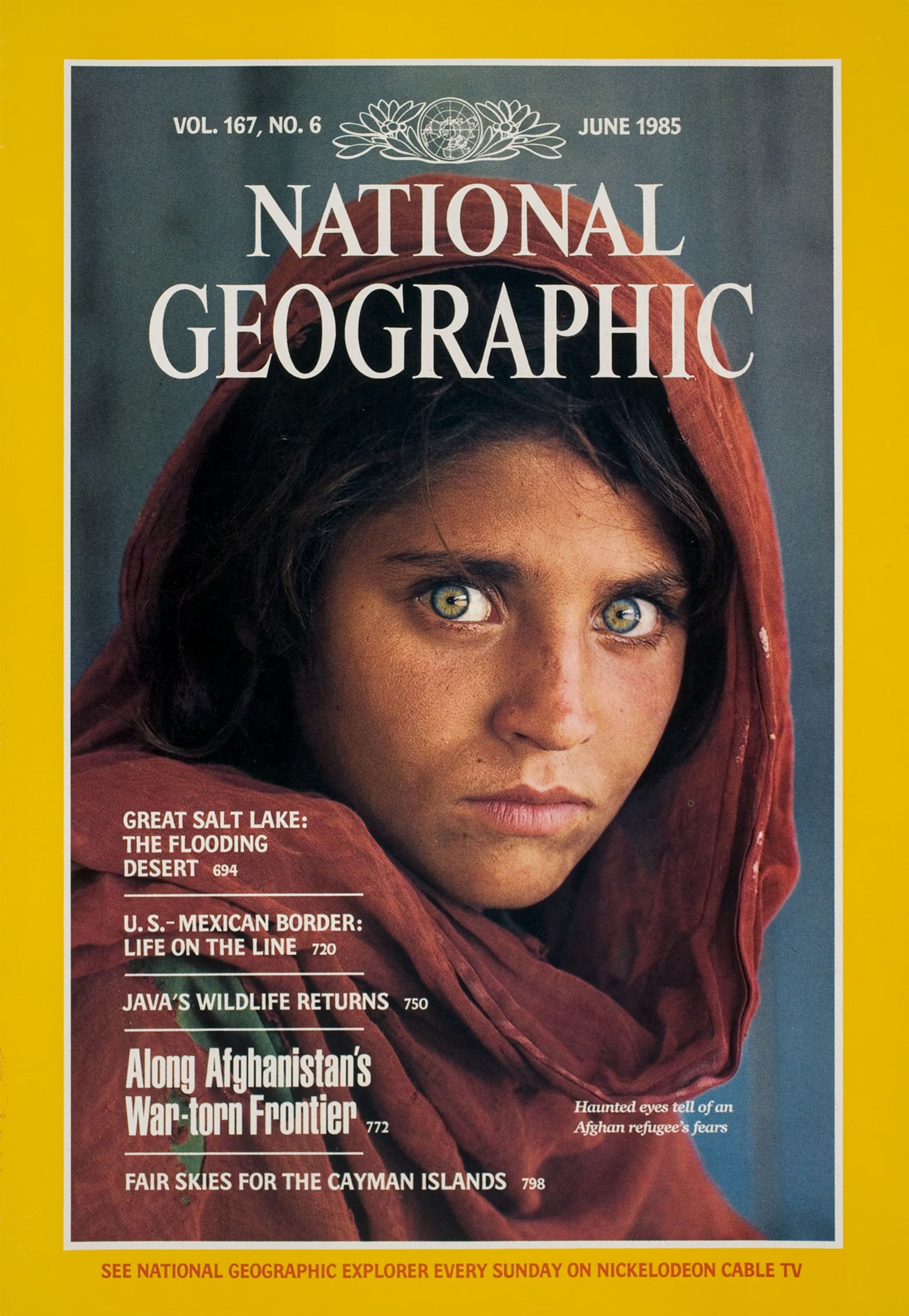
McCurry later said that the magazine received thousands of letters. People wanted to send the girl money, clothes and other forms of help, while some men even offered to marry her.
But one small line printed directly on the cover is especially revealing:
Haunted eyes tell of an Afghan refugee’s fears.
This caption did more than describe the photograph.
It quite literally told the reader what they were supposed to see in the girl’s eyes:
fear;
war;
trauma;
the suffering of the Afghan people.
Viewers read into her gaze a mixture of pain, dignity, defiance, vulnerability and inner strength.
For millions of people, this girl became the embodiment of Afghanistan - a country devastated by war, yet at the same time proud and unbroken.
But it is important to understand that all of these were interpretations made by outside observers.
Who She Was Actually Looking At
At that particular moment, the girl was not looking at the war or into the future of her country.
She was looking at the photographer - an unfamiliar adult man - and into the lens of a camera she may never have seen so closely before.
She was in an unusual situation in which she might have felt uncomfortable, wary or even angry.
So at least some of the tension in her gaze may have been directed at the photographer himself.
The world saw Afghanistan in her eyes.
But she herself may simply have seen a stranger with a camera.
This is one of the central contradictions of the photograph.
The image seemed to allow millions of people to come closer to the lives of Afghan refugees, yet at the same time it told them almost nothing about the actual person in the picture.
Her name was unknown.
No one had heard her voice.
No one had asked what she thought about the photograph.
For seventeen years, the world knew her simply as “the Afghan girl.”
The real person effectively disappeared behind a universal image of a refugee, a child of war and a symbol of an entire country.
How the “Afghan Girl” Got Her Name Back
It was only in 2002 that a National Geographic team returned to Pakistan to search for the woman from the famous cover.
It was not an easy task.
There was no name, no address and no precise information about her family. Several women appeared claiming to be the girl in the photograph.
Eventually, the researchers found Sharbat Gula, who by then was an adult woman with a husband and children.
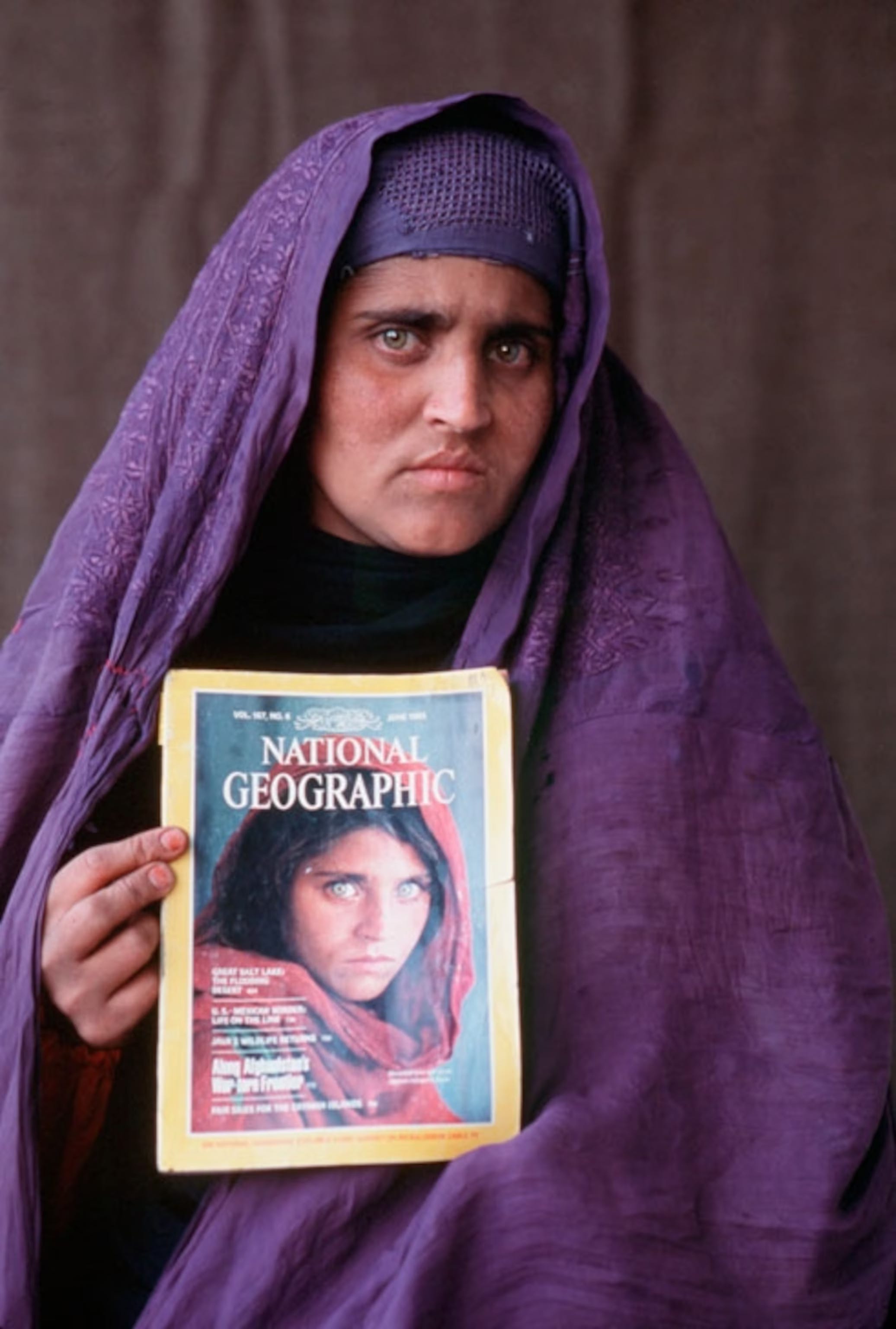
Her identity was confirmed through comparisons of facial features, distinctive scars and iris-recognition technology.
There is an almost symbolic irony in this:
the very eyes that had turned her into a world-famous image helped, seventeen years later, to give that image a name.
But Sharbat Gula’s life looked nothing like the triumphant story of a global celebrity.
Two Biographies
While her photograph travelled around the world, appeared in books, hung in galleries and was sold as a fine-art print, Sharbat herself lived a modest life between Afghanistan and Pakistan.
She married young, raised children, lived through illness, loss and repeated displacement.
The photograph acquired a biography of its own.
It became famous, influential and commercially successful.
Sharbat Gula had a very different biography - the biography of a woman surviving war, poverty, illness, political upheaval and the unstable status of a refugee.
This does not mean that the photograph brought only harm.
It drew attention to the situation of Afghan refugees, encouraged people to help and later contributed to educational and humanitarian initiatives. After Sharbat was identified, she also received some financial and medical assistance.
But none of this removes the central question:
Who has the right to explain what her gaze means?
The photographer?
The magazine’s editors?
The Western viewer?
Historians, journalists and art critics?
Or Sharbat Gula herself?
When a Person Disappears Behind a Symbol
This story shows very clearly how symbolic - and sometimes manipulative - images are created.
We interpret what we see through our own experience, beliefs and emotions, as well as through assumptions and stereotypes imposed by society or the media.
In this way, a real person gradually disappears behind a label, while their actual experiences are replaced by meanings assigned to them by others.
Afghanistan is often presented to the outside world through exactly these kinds of images:
an armed man,
a woman in a burqa,
a refugee child,
a ruined city,
a mountain landscape.
Each of these images may be true.
But none of them is the whole truth about the country.
It is precisely this distance between the image of a country and the real people who live there that I am trying to bridge in my World on Bookshelf project.
I want to hear the voices, thoughts, experiences, pain and dreams of real people; to compare the way a country and its people are seen by outsiders with the way those people understand and describe themselves.
For decades, the world looked into the eyes of the “Afghan Girl” - but almost never heard the voice of Sharbat Gula.
Perhaps truly getting to know a country begins at the moment when we stop merely looking at images created by others - and finally allow people to speak for themselves.