


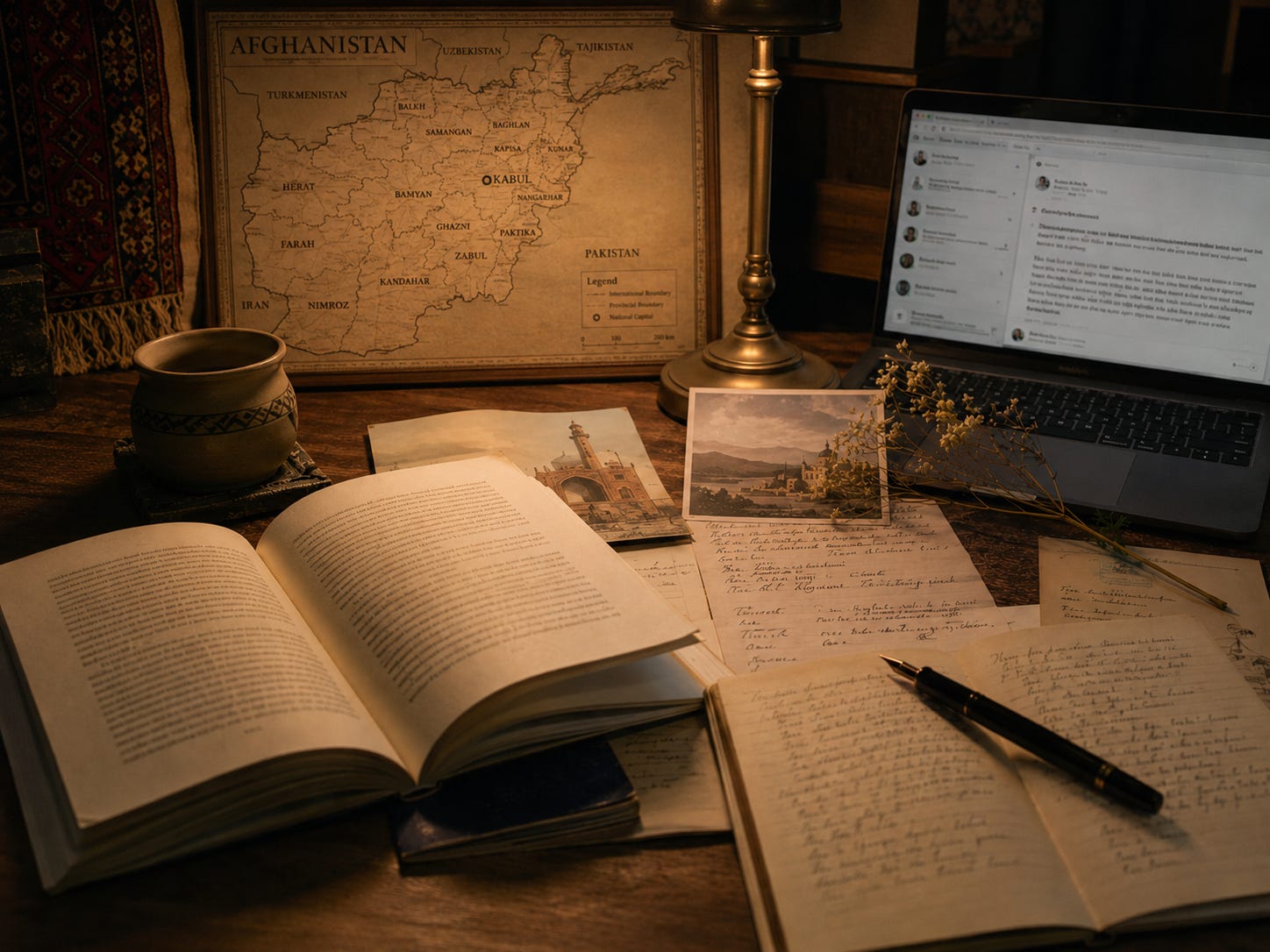
“Even after all these years, I can still remember the smell of the Russian tanks. Some memories of war simply never leave you.”
This was written to me by a man I have never met. He grew up through two wars: first the Soviet war, and then the civil war that began after Soviet forces withdrew and proved no less destructive. He spent much of his childhood as a refugee in Pakistan. He had no particular reason to write to me about tanks. I had asked him about something else entirely.
But he saw that the letter had come from Ukraine - and immediately recognised parallels between our war and his own traumatic experience.
The Book
Maiwand Banayee is the author of Delusions of Paradise: Escaping the Life of a Taliban Fighter, published last year by the British publisher Icon Books.
It is the story of his own radicalisation. A teenager who grows up amid war loses his home, ends up in a refugee camp, enters a madrasa - and gradually begins to dream of dying for his faith. Not because of some dark transformation. Because of hunger, humiliation, the need to feel that he belongs, and a very simple system of explanations that, at that moment, proved more convincing to him than all the alternatives.
But the second half of the book is more important than the first. It is the story of how a person begins to ask questions - and finds a way out of the world that had seemed to be the only possible one.
By that point, I had already read more than twenty books about Afghanistan. And yet this one gave me a voice that had been missing from those twenty: not a victim, not an analyst, not a former commander. Just a boy who came within one step of becoming one of them - and did not.
One Email
After finishing the book, I did something I had not originally planned at all: I wrote to the author himself.
I told him about World on Bookshelf - about my attempt to read a country not through one definitive book, but through as many different voices as possible, including voices that argue with one another. And I singled out one thought of his that had stayed with me most deeply:
“when people read books solely about their own culture, they become xenophobic and ethnocentric.”
It seemed to me that this was not only about Afghanistan. We too know most countries through brief news reports, other people’s media images and ready-made stereotypes. Very little of what people in those countries write about themselves is available in Ukrainian.
So I asked whether it might be possible to make a Ukrainian translation of his book available through my non-commercial project.
I was not sure I would receive a reply at all.
The Reply
Maiwand’s email turned out to be far more personal than I had expected.
He immediately drew a parallel between the war we are living through and the war he had lived through. The line about the smell of tanks that opens this essay comes from that very email.
For me, that was the moment when the book stopped being simply a book about a distant country. Behind the text was a living person. A person who, decades later, recognised something familiar in what is happening to us now.
Maiwand wrote that he would be very happy to see Delusions of Paradise made available to Ukrainian readers. And he explained why: in his view, the Afghan experience matters to us not so much as an account of war itself, but as a warning about what can happen to individuals, families and societies in the years and decades after the fighting ends.
How the Permission Came About
The rights are managed by the publisher, so Maiwand could not authorise the translation himself. But he did not simply reply, “Contact the publisher.” He forwarded my email to his editor, copied me in, and wrote that he supported the idea.
A full non-commercial translation was, understandably, not something the publisher could authorise. Instead, they offered 8,000 words - a substantial extract that could be translated and published free of charge.
I chose three consecutive chapters: “Rise of the Taliban, 1994”, “From Refugee to Talib, 1994-2001” and “Myths of the Afterlife”. Together, they form an almost self-contained story within the larger one: how the Taliban emerged, how Maiwand came close to it, and how ideas about jihad, martyrdom and reward after death shaped his worldview at the time. Maiwand responded to the selection with one word: excellent.
The Message
When the translation was almost ready, I wrote to Maiwand that I wanted to tell this story to readers of the project. I also said it would be especially meaningful if, alongside the Ukrainian text, he could offer a few words directly to Ukrainian readers.
He agreed immediately.
His message now appears at the beginning of the translation - in both Ukrainian and English. It is brief. He recalls how, as a boy, he collected shrapnel from Soviet bombs and sold it to local merchants as scrap metal, without understanding how deeply the aftermath of that war would shape an entire generation.
And he closes with this thought: never let war take away your humanity or your ability to question hatred.
It seems to me that this is one of the most important things an Afghan can say to a Ukrainian today.
In one of his emails, Maiwand wrote a line that perhaps sums up this whole story better than I can:
“I agree that the personal connections formed through books are often as impactful as the books themselves.”
I still want to read the world through books. But now I know that after the last page there is one more step: write to the author. And sometimes, the author writes back.
A Message from Maiwand Banayee to Ukrainian Readers
Dear Ukrainian readers,
It is a great privilege to see chapters from my book, Delusion of Paradise, translated into Ukrainian. I am especially grateful to Vitaliy Karanda for bringing them to Ukrainian readers.
I grew up during the Soviet war in Afghanistan and spent much of my childhood as a refugee. Even after Soviet forces withdrew from Afghanistan, war remained part of ordinary life. As a boy, I remember collecting shrapnel from Soviet bombs and selling it to local merchants as scrap metal, without understanding how deeply the aftermath of war would shape my generation.
Afghanistan and Ukraine have different histories, but the consequences of war can continue long after the fighting ends. My experience taught me how war can lead to displacement, anger, loss of identity, propaganda and radicalisation. These were the forces that gave rise to the Taliban and eventually drew me into their radical worldview.
If there is one lesson my life has taught me, it is never to let war take away your humanity or your ability to question hatred. Even in the darkest times, people can choose compassion over fanaticism and hope over despair.
With love and hope for Ukraine,
Maiwand Banayee
Ukrainian Translation
With the permission of Maiwand Banayee and Icon Books, I am making available a Ukrainian translation of three chapters from Delusions of Paradise: Escaping the Life of a Taliban Fighter — approximately 8,000 words in total.
The authorised extract includes:
8. Rise of the Taliban, 1994
9. From Refugee to Talib, 1994–2001
10. Myths of the Afterlife
The translation was prepared specifically for World on Bookshelf, an independent non-commercial educational project, and is published with the formal permission of the rights holder.
The Ukrainian edition also opens with a personal message from Maiwand Banayee to Ukrainian readers, written especially for this publication.
Download the Ukrainian Translation
The PDF is suitable for reading on a computer or phone.
The EPUB version can be opened in Apple Books, PocketBook, Kindle and other e-readers.

Copyright notice
Based upon the book: Delusions of Paradise by Maiwand Banayee
Ukrainian translation of Chapters 8–10 published with permission from Icon Books for non-commercial and educational use as part of World on Bookshelf.
Ukrainian translation by Vitaliy Karanda
Original edition:
Maiwand Banayee, Delusions of Paradise: Escaping the Life of a Taliban Fighter, Icon Books.
Find the original English edition
Every book in this project is recorded on the “open shelf” — a living, real-time register.
When tyranny emerges, some remain silent and ignore our wounds. Hate is natural, but compassion is that little candle in the storm. Keeping it lit is our legacy to those who will follow.