


I have become so fascinated by Afghanistan that I still cannot move on to the next country in my World on Bookshelf reading project.
I continue almost obsessively to unravel this tangle woven from deeply rooted patriarchal traditions, ancient religious beliefs, and archaic ideas about honour and shame.
After the book by Norwegian journalist Åsne Seierstad about the Kabul bookseller, I came across another extremely interesting work of investigative journalism - this time by Swedish journalist Jenny Nordberg, The Underground Girls of Kabul.
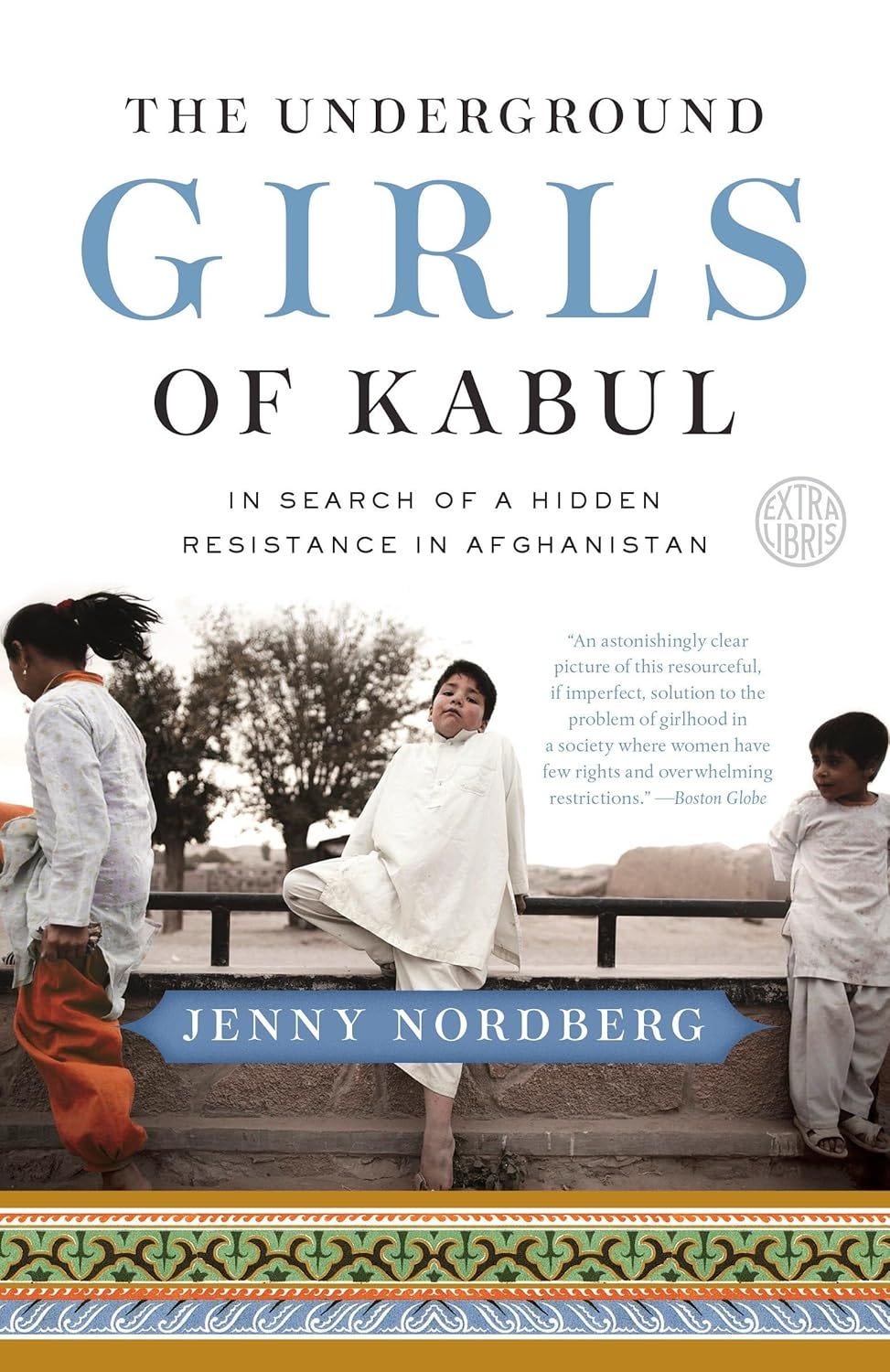
It is a story about girls known as bacha posh, which literally means “dressed like a boy” in Dari.
Nordberg’s investigation begins with an unexpected encounter with a strange practice in one Kabul family: the parents dress one of their four daughters in boys’ clothes, cut her hair short, give her a male name, and publicly present her as their son.
The explanation is, unfortunately, obvious.
In a deeply patriarchal society, a family in which no boys are born may be seen as incomplete, almost “defective.” So by creating this artificial appearance of having a son, the parents try to raise the status of their family.
As the Swedish journalist discovered, although the practice remains largely hidden, it has been quite widespread among Afghans for centuries.
Dressing a girl as a boy immediately gives her a completely different quality of life.
A bacha posh girl can move around more freely, go to school, help her parents by working as a messenger or assistant in shops and small businesses. She can also accompany her sisters, or even her mother, if they want to go to the bazaar.
Otherwise, women and girls are often not allowed to move around outside without a male companion.
Interestingly, some Afghan women firmly believe that dressing a daughter as a boy and presenting her as one in society can help the family finally have a real boy - the long-awaited male heir and future protector.
For this reason, families in which only girls continue to be born may even be secretly advised by Islamic mullahs to temporarily turn one of their daughters into a bacha posh.
Nordberg found families who sincerely believed that this very practice had “helped” them have a boy as their next child.
And so the “chosen” girl-boy has the opportunity to enjoy male rights and privileges until puberty.
But only until puberty makes it impossible to continue the game of disguise.
Then the bacha posh is expected to become a woman again.
Yet, as Jenny Nordberg shows in her book, some girls do not want to return to the status of an oppressed and largely powerless person.
They try to resist their parents’ will and even the physiological changes happening to their bodies, continuing this gender role that gradually becomes far less innocent.
Because sometimes it can permanently affect the child’s social and gender identity.
The book is extremely interesting and keeps you in constant tension, almost like a psychological thriller.
But in essence, it tells a much broader and much older story.
Afghanistan, where for centuries men have tried to control not only land and wealth but also the very continuation of the family line through control over women’s bodies, marriages, sexuality and the birth of sons, still preserves and cultivates an archaic code of honour, power and ownership.
An old formula widespread in Afghan and Pashtun society - zan, zar wa zamin, “women, wealth and land” - captures this logic very concisely.
Within it, a woman appears not as an autonomous individual, but as part of a man’s so-called namus: the honour, reputation, property and power of the family.
And yet, even in such a restrictive and oppressive environment, a person finds ways to get a taste of freedom.
Even if, in order to do so, she has to change her gender - at least in the eyes of society.