


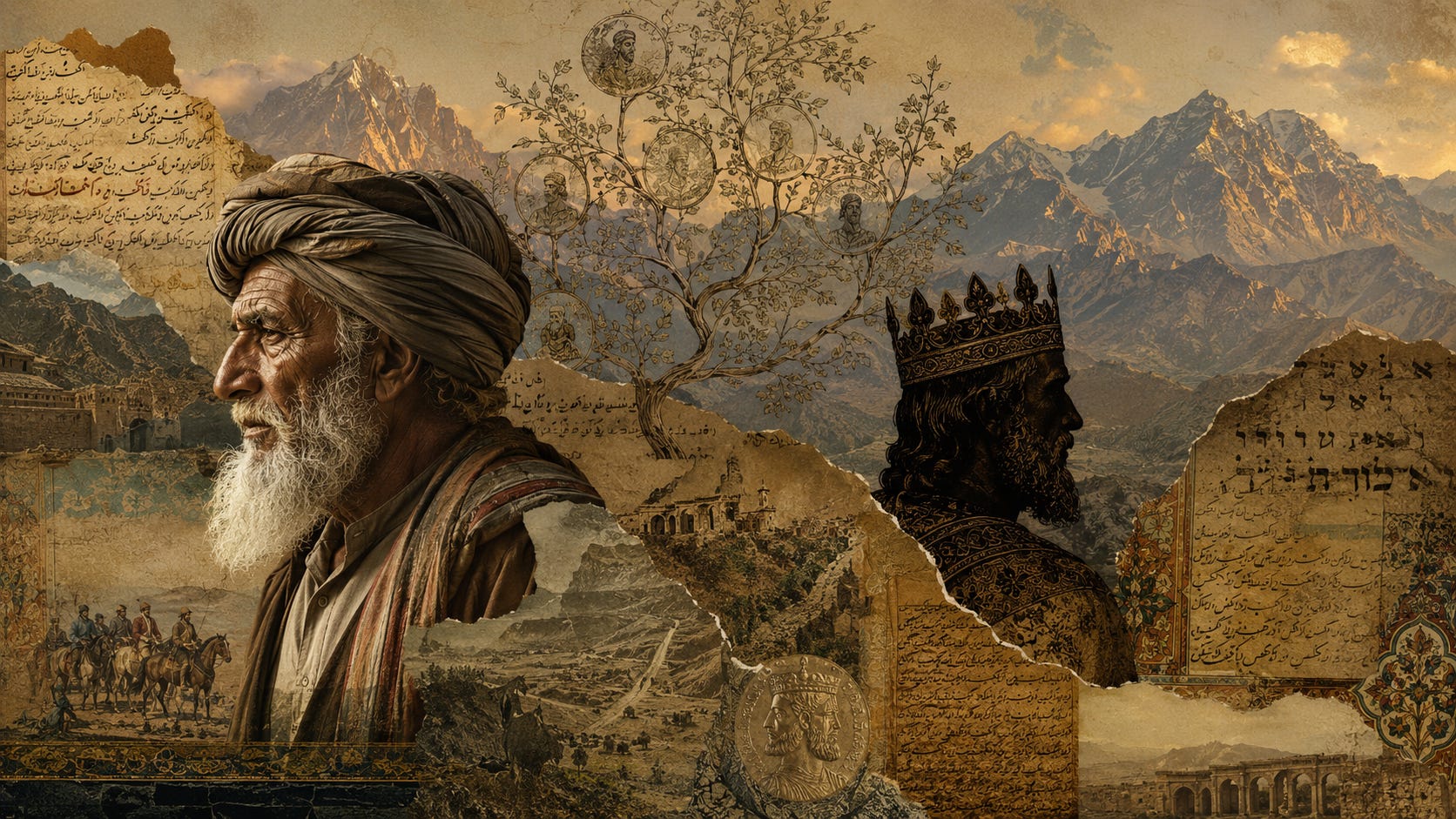
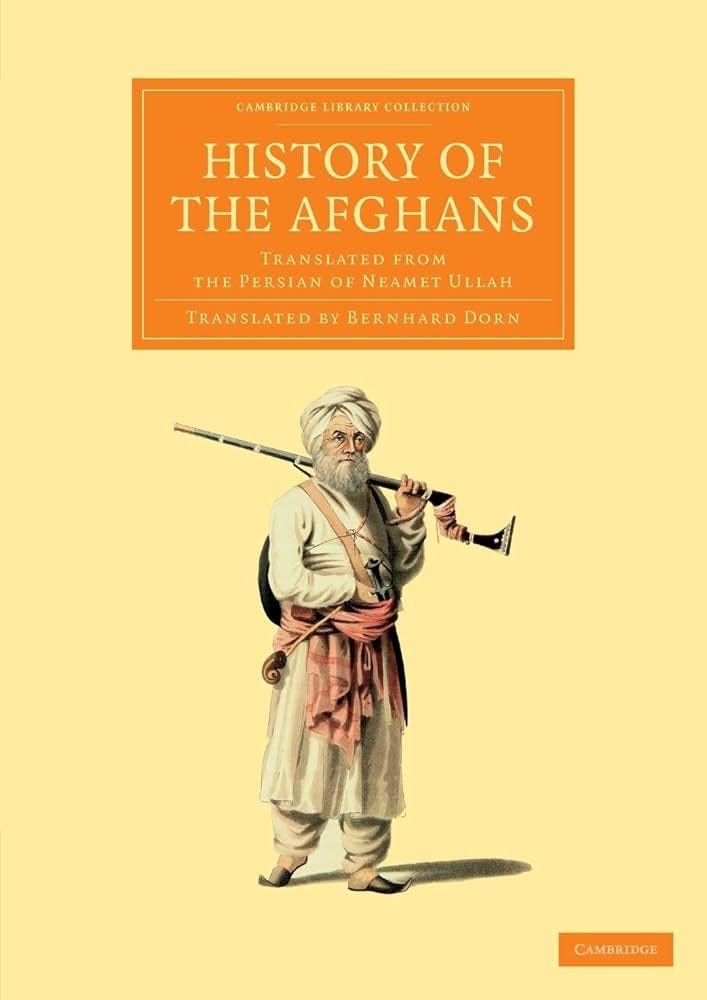
I am currently reading a rather extraordinary book - Niʿmat Allah’s History of the Afghans.
It is an early seventeenth-century Persian-language chronicle compiled in India, in which the author attempts something almost impossible: to bring together into a single history the origins of the Afghans, their tribes, genealogies, rulers, saints, and legends.
One thing should be clarified from the start: when this book speaks of “Afghans,” it primarily means Pashtuns.
And Niʿmat Allah explains their origins in a way that makes a modern reader instinctively stop and ask:
Niʿmat, come on! Seriously?
Because according to one of the best-known Pashtun genealogical traditions, they are descended from... the ancient Israelites.
Not metaphorically. Quite literally.
If we simplify the genealogy as much as possible, it looks something like this:
Jacob / Israel → King Saul → Afghana → ... → Qais → the Pashtun tribes.
The appearance of an ancestor named Afghana is particularly wonderful.
According to the legend, he was descended from the biblical King Saul - Talut in the Muslim tradition - and became the ancestor of the people who would later be known as Afghans.
Almost too convenient and logical.
And then an even more important figure enters the story: Qais Abd al-Rashid.
According to tradition, he lived during the time of the Prophet Muhammad, travelled to Medina, converted to Islam, and then returned to his people.
Qais had three sons - Sarban, Batan, and Gurgusht - from whom traditional genealogies derive a vast number of Pashtun tribes and clans.
So no matter how distant two Pashtun tribes may be from one another, if you climb far enough up the family tree, eventually you are supposed to arrive at Qais.
And above him - Afghana.
And still higher - Israel.
And this is where the story becomes even more interesting.
Several centuries after genealogies of this kind appeared, European travellers began arriving in Afghan lands, and some of them suddenly started finding confirmation of the legend... in the appearance of the Pashtuns themselves.
The traveller and missionary Joseph Wolff, for example, wrote that although he did not generally consider Afghan appearance to be “Jewish,” he was struck by the resemblance to Jews among some Yusufzais and inhabitants of the Khyber region.
Other nineteenth- and early twentieth-century authors also described what they called “Jewish facial features” among some Afghans.
Today, of course, such physiognomic arguments prove absolutely nothing.
But for the history of the legend itself, this is a fascinating detail:
the tradition already existed, and people who knew it began to see confirmation of it right in front of their eyes.
From our modern perspective, the idea may seem particularly paradoxical.
The Pashtuns are one of the peoples most strongly associated with Muslim Afghanistan, and yet an old tradition places them directly within the history of Bani Israel - the Children of Israel.
But it is important not to look at the seventeenth century through the eyes of the twenty-first.
For a Muslim author, Jacob, Saul, David, and Solomon were not “foreign” Jewish figures. They were also part of Islamic sacred history.
So a genealogy of this kind did not distance the Pashtuns from Islam.
Quite the opposite: it placed them within a great sacred history that began long before Muhammad and ultimately led to him.
Although, if you already think the question of Afghan origins is finally settled, do not be too quick.
The Israelites were far from the only theory.
At different times, writers attempted to trace the Afghans back to Armenians, Persians, Turks, Tatars, Mughals, and even the ancient Caucasian Albanians.
Caucasian Albanians, that is - not the modern Albanians of the Balkans.
Some authors were particularly attracted by the resemblance between names such as Aghvan and Afghan, and from that similarity grew entire theories of migration through the Caucasus and Armenia.
But perhaps the most interesting question here is not even which of these authors was right.
I find myself increasingly interested in something else:
why does a people need an ancestor like Qais in the first place?
Perhaps because a myth of origin does not so much explain the past as create a sense of common identity in the present.
Tribes may fight one another, live in different valleys, speak different dialects, follow different customs, and maintain their own genealogies.
But if you climb high enough up the family tree, eventually they all meet.
At Qais. And then they are all one family.
That is probably why it may not matter all that much whether Qais Abd al-Rashid really existed.
The much more interesting question is:
WHY was it important for people, for centuries, to believe that he did?