


In my “literary introduction” to Afghanistan, I try to “hear” - meaning, to read - as many voices as possible: people from different social groups, political camps, ethnic communities, and religious backgrounds.
Whenever I encounter one particular position, I almost immediately try to find what I think of as a counterpoint - an opposing view or simply another perspective on the same situation.
It seems to me that this is one way, at least, to reduce the risk of seeing events from only one side: to look at them in turn through the eyes of opponents, participants, or witnesses, while trying to preserve a position of my own that remains, in a sense, “above” the conflict of ideas.
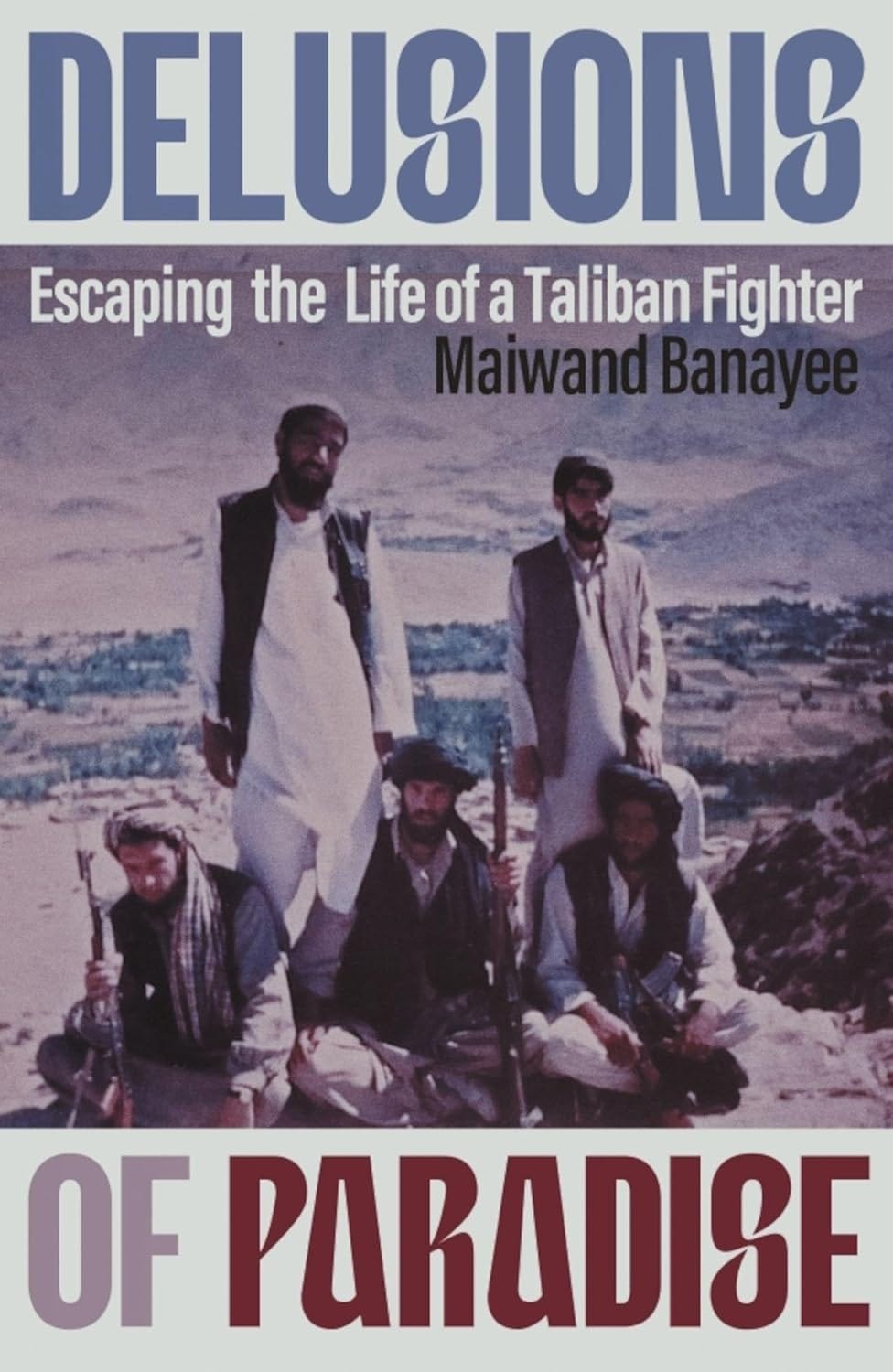
That is exactly why I was drawn to the memoir by Afghan author Maiwand Banayee, Delusions of Paradise: How I Almost Became a Taliban Fighter.
By this point, I had already read quite a lot about the Taliban - from the testimonies of persecuted and deprived women, to the analytical reflections of military advisers and politicians, to the memoirs of leaders and supporters of the radical movement itself, as well as literary reconstructions of those events.
But here was an opportunity to see yet another angle - the perspective of someone who himself began moving towards radicalism, and then turned away from that path.
The book’s description promised a candid story of a man who grew up amid war in Afghanistan and, as a young man, fell under the influence of religious radicalism, nearly becoming a Taliban fighter.
A story about fanaticism, gradual disillusionment with its promises, and the painful return to one’s own life and freedom of choice.
I should add that this is not the first time I have read memoirs by ordinary people from Afghanistan.
Some of these books are partly “written” in partnership with Western journalists or authors, who help shape and edit them for a particular audience.
To be frank, books of this kind rarely impress me primarily because of their literary value.
But for me, their greatest appeal lies elsewhere.
They allow us to witness the life of an ordinary person - not a ruler, political leader, or recognised authority connected to major historical events, but someone who experiences the everyday consequences of those same great upheavals.
It is a completely different cross-section of reality.
You do not always see it in news reports or historical chronicles.
Because this kind of life - not particularly romantic, but brutally real - often remains outside the attention of journalists, photographers, and historians.
Maiwand begins his story with his childhood in one of the poor outskirts of Kabul, where he witnessed the horrors of the civil war that unfolded after the withdrawal of Soviet troops and the collapse of the pro-communist state.
Kabul turned into a battlefield between different mujahideen factions which, once they had lost their common enemy, quickly remembered their political, ethnic, tribal, and personal differences and began a ruthless struggle for power.
The city was effectively divided into zones controlled by different warlords, with the borders between them running literally through its streets.
One thing immediately caught my attention: the main character’s name.
Maiwand is a small Afghan village near Kandahar, close to the site of one of the most famous battles of the Second Anglo-Afghan War in 1880.
There, Afghan forces inflicted a serious defeat on the British, and the battle later became one of the symbols of Afghan resistance.
So Maiwand was named after this important victory.
According to him, the name always placed a certain pressure on him: he felt a moral responsibility to live up to it.
But as a child, he felt anything but heroic.
Maiwand was severely bullied by boys in his neighbourhood, while his father regularly reproached him for being timid and unable to defend himself.
At first, this detail seems secondary.
But gradually it becomes important: the desire to stop being weak, to prove his masculinity, and finally to live up to what others expected of him would later combine with very different circumstances.
Fleeing the war, Maiwand’s family ended up in a camp for Afghan refugees in Pakistan.
It was there that religious radicals gradually began influencing him and other boys already traumatised by war.
They were taught to see the meaning of life in jihad, prepared for self-sacrifice, and persuaded that death in a religious war opened a direct path to paradise.
For a teenager who had grown up surrounded by violence, humiliation, and a constant sense of helplessness, this worldview suddenly offered simple answers: who was to blame, what he should fight for, who he should become, and even what was worth dying for.
This part of Maiwand’s story was perhaps the most interesting to me.
Radicalisation here does not appear as some incomprehensible transformation of a “normal” person into a fanatic.
On the contrary, step by step, you begin to see how personal experience, war, trauma, the need to belong to a community, the desire to feel strong, and the attraction of a simple system for explaining a complicated world can come together in a very dangerous combination.
But in the end, Maiwand managed to escape that trap.
After leaving Afghanistan, he went through a deep crisis of faith, belief, and identity.
He had to search again for meaning in his life and, in effect, rebuild the basic points of reference through which he understood himself.
And interestingly, one of the important tools in this process became knowledge, education, and exposure to other ways of seeing the world.
Perhaps that is why, toward the end of his journey, Maiwand formulates an idea that resonated particularly strongly with me in the context of my own “literary introduction” to Afghanistan:
“The state should invest in translating scientific and Western literature, because when people read only books about their own culture, they become xenophobic and ethnocentric.”
Of course, this idea can be understood much more broadly than simply as a call to translate Western books for Afghan readers.
It is about the danger of any closed cultural space in which a person reads only about “their own,” listens only to “their own,” and gradually begins to see their own experience, culture, and value system as the only possible point of reference.
That is precisely why we need translations - of fiction, memoirs, historical studies, scientific works, and books on society and politics.
Reading “the other” does not mean agreeing with them.
It is, rather, an opportunity to spend a few hundred pages looking at the world through someone else’s eyes, and then return to your own picture of the world with the awareness that it is not the only one.
And perhaps that, for me, is the real meaning of this “literary introduction” to Afghanistan: not to find one correct version of the country, but gradually to piece it together from as many different, contradictory, and sometimes mutually exclusive human voices as possible.